Overview
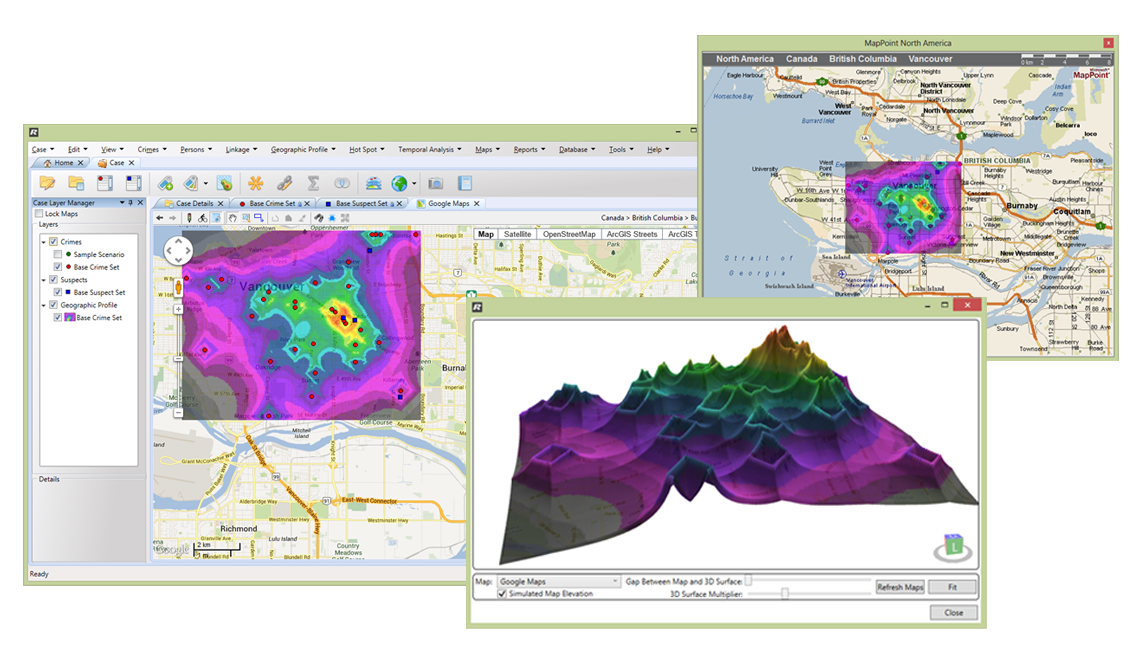
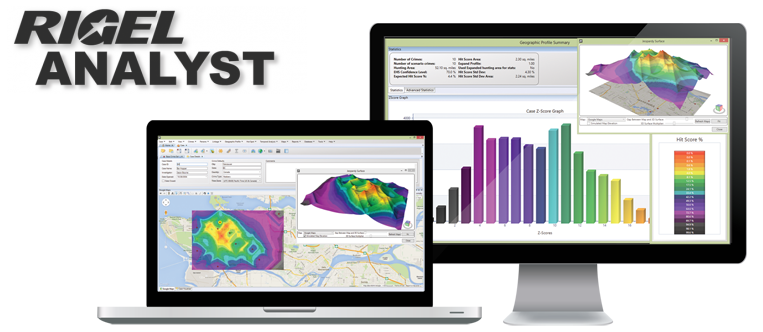
Rigel Analyst is the premier geographic profiling application for civilian law enforcement. It is used by police agencies worldwide in support of serial crime investigations. Rigel Analyst uses ECRI’s patented Criminal Geographic Targeting (CGT) algorithm to prioritize suspects and addresses or to highlight specific geographic areas, enabling investigators to focus their resources more efficiently.
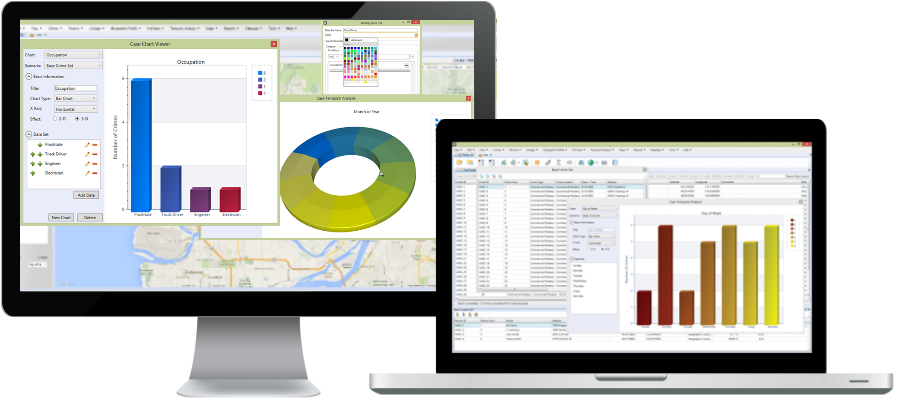
Rigel Analyst is designed for use by crime analysts and investigators. The software is easy and intuitive to use. The workflow is streamlined by years of practical experience, from automated input and geocoding of crime and suspect data to template-generated reports at the push of a button. Rigel Analyst works directly with existing crime, suspect and map data in common file formats, and smoothly integrates common GIS software.
Rigel Analyst is a highly effective investigative tool. A geographic profile prepared with Rigel Analyst will on average locate an offender’s anchor point to within 5% of the area covered by the crimes. This improved geographic focus, together with the ranking of suspects by location, helps to reduce investigation effort, saves money and resources, and leads to quicker arrests.
It is highly recommended that crime analysts and investigators planning to add geographic profiling to their agency’s capabilities should complete the Geographic Profiling Analyst (GPA) certification training. Please see the training page for more details.
Licensing Options
Standalone
The standalone license provides a single copy of the software and license key to be installed on one PC for one user.
Multi-User
The multi-user license supports up to 5 non-concurrent users sharing one system at one site. Each user requires their own license key.
Network
The network version is composed of a Network Master License and one or more Concurrent User Licenses. Concurrent license use is managed by the central license server on the network. Using the Network License model, Rigel Analyst can be installed on as many systems as you want within your network, but can only be used simultaneously by the total number of Concurrent User Licenses you own. E.g. if you have 4 users and 2 Concurrent User Licenses, all 4 users could have Rigel Analyst installed on their computers, but only 2 could use Rigel Analyst at any given time.
GIS Support
ESRI ArcGIS 9.x and 10.x ![]()
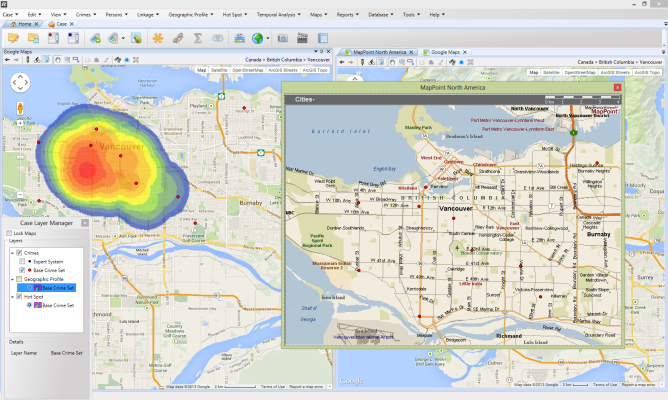
Microsoft MapPoint 2002, 2004, 2006, 2009 and 2010 ![]()
Pitney Bowes MapInfo Professional 8.5, 9.x and 10.x ![]()
Google Maps (requires internet connection) ![]()
System Requirements
Workstation
The following system requirements are typical for running Rigel with ESRI ArcGIS. The system requirements are lower for running with Google Maps or Microsoft MapPoint.
| CPU Speed: | 2.2 GHz dual core or higher |
| Processor: | Intel Core Duo, Pentium 4 or Xeon Processors |
| Memory/RAM: | 2 GB or higher |
| Display: | 24 bit color depth |
| Resolution: | 1024 x 768 recommended or higher at Normal size (96dpi) |
| Swap Space: | Determined by the operating system, 500 MB minimum. |
| Disk Space: | 2.4 GB and up to 50 MB of disk space maybe needed in the Windows System directory (typically C:\Windows\System32). You can view the disk space requirement for each of the 10.0 components in the Setup program. |
| Graphics: | 24 bit capable graphics accelerator. An OpenGL 2.0 or higher compliant video card is required, with at least 128 MB of video memory, however 512 MB of video memory or higher is recommended. |
| Network Card: | Simple TCP/IP, Network Card or Microsoft Loopback Adapter is required for the License Manager. |
Network License
Windows Workgroup Network
- Windows computers connected to a network via TCP/IP. Each computer running Rigel needs a local IP address and access to the server via TCP/IP in order authorize concurrent license use.
- The license server must have a static IP address on the LAN, and a free USB port.
Thin-client Environments
- Citrix Server / Windows Server with Terminal Services.
- Users log on to the Server as interactive thin clients to access Rigel (no ECRI software on the clients in this case)
- Rigel software is installed on the server computer for the Terminal Services.
- One physical computer with a static IP address and a free USB port to run the license server (may be the same computer where the software resides, or a different computer).
Typical Rigel Analyst Applications
These are some examples of actual cases where Rigel Analyst software assisted in solving the case.
Case 1: The Chair Burglar – Irvine, California
Crime analysts in Irvine, California (a suburb of Los Angeles) noticed a pattern of an unusually high number of professional residential burglaries in the early evening hours in locations where houses were easily accessible from the rear via a public lane or green belt. A additional detail was noted that the burglar often employed a deck chair or other similar item to assist his quick escape over the rear fence. Once noticed, the pattern was found to extend back for many years, and moved from one neighborhood to another. Analysts surmised that the burglar was driving to the neighborhood and then casing the area and conducting burglaries over a period of a few weeks before moving on.
A time-series analysis was prepared showing the pattern of movement from one neighborhood to another. When the pattern clearly showed movement into a new neighborhood, analysts used the latest geographic profile to suggest possible anchor points where the offender might be parking a vehicle in the neighborhood, and patrol officers were asked to watch those locations for a week.
On the first evening officers spotted a suspicious rental vehicle at one of the suggested locations. Subsequent investigation via the rental agency confirmed a likely suspect for the burglaries, and GPS tracking and covert surveillance were employed to tie to suspect to a subsequent burglary. A large amount of stolen merchandise was recovered from the suspect’s home, and DNA confirmed a link to previous burglaries in the lengthy series. Irvine police found that this prolific burglar had been active for many years, responsible for single-handedly raising the crime rate in Irvine through millions of dollars worth of stolen property.
Geographic Profiling Analyst: Lorie Velarde (Irvine PD)
Case 2: Rural Cottage Burglaries – Midland, Ontario, Canada
Ontario Provincial Police (OPP) were investigating a series of over 80 burglaries in a cottage community near Midland, Ontario. Investigators had numerous suspects for these crimes. Using the Geographic Profiling, investigators were able to focus the investigation on a small area of the community.
Surveillance was conducted on the one suspect who lived in the peak profile area and sufficient evidence was gathered to result in an arrest. The offender was subsequently charged with numerous (50) offences and stolen property recovered. His residence was located in the top 0.06% of the total area of the crimes (an area less than 100m x 100m).
Geographic Profilers: Brad Moore (OPP)
Case 3: Bank Robberies –Staffordshire, England (Operation Tornado)
Police from several jurisdictions were seeking a common offender in a series of robberies of financial institutions throughout central England. The older white male, simulating a weapon, had struck 32 times between September and June.
The victimized banks were in small towns and villages spread over some 20,000 square kilometres. Geographic Profiling aided investigators by directing the search for the offender’s residence on an area of 2,015 sq. km (10.3% of the area under consideration) and helped in focusing a CrimeWatch appeal to the general public. A resulting tip from the public lead to the offender, who lived in the village of Buxton (within that 10.3% area) being arrested and charged with multiple counts of robbery.
Geographic Profiler: Scot Filer (RCMP)
Confidentiality restrictions prevent disclosure of most case details, but additional information may be obtained by law enforcement personnel by contacting the agency involved. Contact ECRI for assistance.